Your Roommate Moved Out: Who Still Owes the Rent in Missouri?
When a roommate leaves a Missouri rental, the first place to look is the lease. A private understanding that each roommate pays half does not necessarily limit what the landlord can demand from a person who signed a joint lease. The answer depends on the actual contract, who signed it, and any later release or amendment.
Moving out, returning one key, or changing an address does not by itself establish that a person has been released from the lease. Before the next rent payment comes due, identify what the landlord agreed to and what the roommates agreed only between themselves.

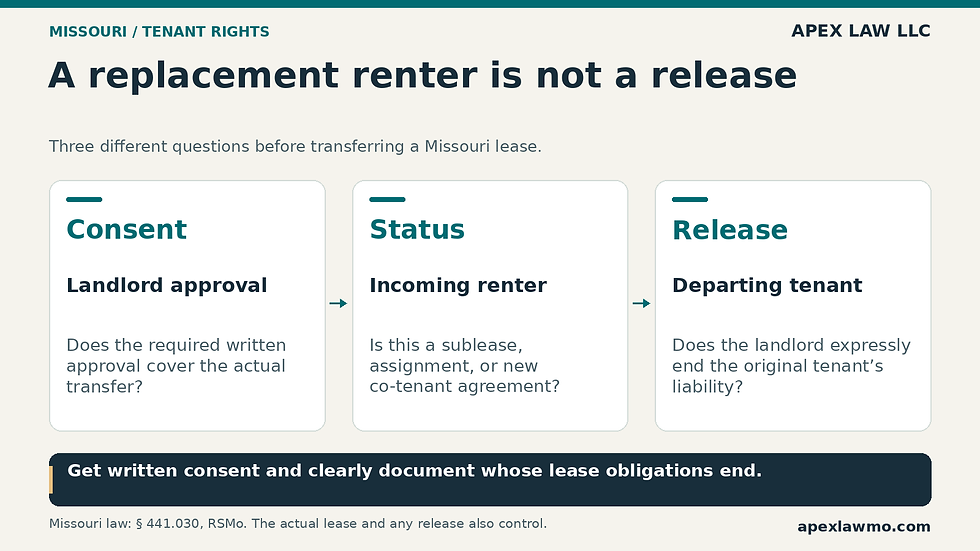
View this graphic at full size. Graphic references: § 441.030, RSMo; § 535.020, RSMo.
One joint lease or separate rental contracts?
Some households sign one lease for the entire apartment. Others have separate contracts for individual rooms. Those arrangements can allocate rent and responsibility differently. Read the provisions identifying the tenants, rent, guarantees, and liability rather than assuming that every shared home operates the same way.
If a lease creates joint and several liability, it may permit the landlord to pursue one responsible tenant for the full covered obligation, subject to the contract and applicable law. A person who never signed may present different questions involving occupancy, an oral agreement, or a subtenancy. A lawyer must examine the actual relationship before deciding who owes what.
What does a fifty-fifty roommate agreement accomplish?
A roommate agreement may help define reimbursement obligations between the roommates. It does not automatically amend the landlord’s lease. If one person pays more than an agreed share to keep the rent current, the agreement, messages, and payment records may matter to a separate reimbursement dispute.
Keep those issues separate in your records. One column can show rent billed by the landlord and payments the landlord received; another can show how the roommates divided those payments among themselves. A transfer between roommates is not necessarily proof that the landlord received rent.
A hypothetical $1,400 apartment
Suppose two tenants sign a lease requiring $1,400 each month and imposing joint and several responsibility for that rent. They privately agree to contribute $700 each. One moves out and stops contributing. Under the assumed lease, the remaining tenant should not assume that paying $700 satisfies the landlord’s entire monthly claim.
The departing tenant likewise should not assume that physical absence ends the obligation. A written landlord release or a new agreement may change the result, but the private split and the landlord’s contract must be read separately. This illustration assumes the quoted liability term actually appears and is enforceable; a room-by-room lease could produce a different answer.
Can you replace the roommate without approval?
Review the lease before advertising the room or moving someone else in. § 441.030, RSMo requires written landlord assent for specified assignments or transfers of an interest, including a tenant’s term not exceeding two years, and also addresses compliance with written lease conditions. Guest, occupancy, and transfer provisions may all be relevant.
An approved replacement should be documented. Determine whether the person becomes a co-tenant, subtenant, or other authorized occupant and whether the departing person is released. Consent to someone living in the unit is not necessarily consent to release another person’s financial obligations.
Does the landlord have to refund the departing roommate’s deposit share?
Missouri’s ordinary deposit-return rule in § 535.300, RSMo runs from termination of the tenancy. One person moving out while the rental arrangement continues does not automatically establish that the entire tenancy ended. The lease, ownership of the deposit funds, and any amendment require review.
The roommates may decide to reimburse one another, but they should document the amount and who receives the landlord’s eventual refund. The agreement should also explain how later damage deductions will be allocated. An undocumented handoff can leave both the departing and remaining tenant expecting the same money at final move-out.
What if unpaid rent leads to court papers?
Do not ignore a demand or summons because you believe the other roommate caused the shortfall. § 535.020, RSMo provides the framework for a Chapter 535 rent-and-possession claim, including a claim for rent actually due. The landlord’s case and a roommate reimbursement claim do not automatically resolve one another.
Save the lease, roommate agreement, landlord approvals, move-out messages, ledger, and payment records. If an eviction case has started, get advice promptly about the court date and the position of each named party.
For related questions, read Can You Sublease an Apartment or Transfer Your Lease in Missouri? and Can Paying the Rent Stop a Missouri Eviction? Understanding § 535.160.
Apex Law provides Missouri landlord-tenant legal services from its St. Louis office. contact Apex Law for review of a Missouri roommate, lease-release, or unpaid-rent dispute. This article gives general information; the signed agreements and subsequent conduct determine many of the relevant rights.


Comments