Can You Sublease an Apartment or Transfer Your Lease in Missouri?
A Missouri tenant should not assume that finding a replacement renter is enough to transfer a lease. § 441.030, RSMo requires the landlord’s written assent for a tenant with a term not exceeding two years, or a tenancy at will or by sufferance, to assign or transfer the tenant’s interest or any part of it. The lease’s own restrictions also matter.
For many apartment renters, the practical issue is straightforward: you want to leave before the lease ends, a friend wants the apartment, and everyone hopes to avoid a vacancy. Written approval can solve part of that problem, but the documents must also explain who remains responsible for rent, damage, and possession.
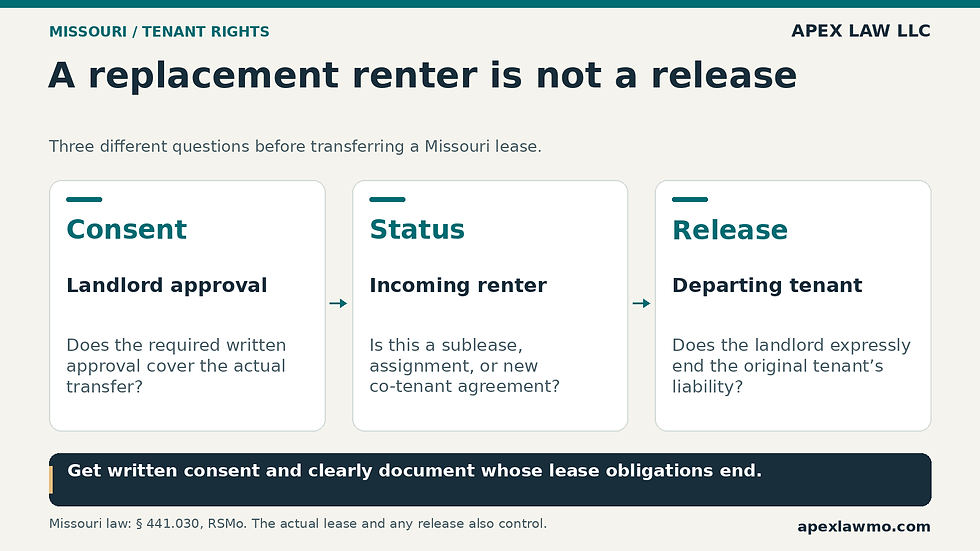
View this graphic at full size. Graphic references: § 441.030, RSMo.
Sublease, assignment, and a new roommate are different arrangements
A sublease generally creates a rental relationship between the original tenant and the subtenant while the original lease continues. An assignment transfers the tenant’s lease interest. Adding an occupant or a co-tenant may instead require an occupancy approval or lease amendment. The label in a text message does not settle which arrangement the parties actually created.
Review who will sign, who pays the landlord, who receives notices, and who has the right to occupy the unit. A short-term rental advertisement may also implicate the lease’s guest or business-use terms and local rules. Permission to host a guest for a weekend should not be treated as permission to rent the home to someone else.
Why written landlord consent matters
For the tenancies described in § 441.030, the statute expressly calls for written assent. It also prohibits violating conditions of a written lease. Do not infer from the statute’s two-year language that a longer lease allows unrestricted transfers; the contract and other applicable law still need review. § 441.030, RSMo is the starting point, not a universal permission slip.
Send a clear request identifying the proposed person, proposed dates, and arrangement. Ask the authorized manager or owner to approve the actual transaction in writing. An application approval or a statement that the person “looks fine” may leave unanswered whether the landlord approved a sublease, agreed to a new lease, or released the departing tenant.
Approval does not automatically release the original tenant
Consent to a replacement occupant and release from contractual liability are separate issues. If you need to be removed from future rent obligations, the agreement should say so clearly and identify its effective date. It should also address any existing balance. A private agreement requiring the newcomer to reimburse you does not necessarily bind the landlord.
Read the guaranty too. A parent or other guarantor may have obligations that are not resolved by a roommate change. Lease amendments should identify whose obligations continue and whose end, rather than relying on assumptions about what handing over the keys means.
A hypothetical lease transfer
Imagine that Jordan signs a one-year St. Louis lease, then receives a job offer elsewhere. Casey agrees to take over the apartment. The landlord emails permission for Casey to live there, but no document releases Jordan. When Casey later stops paying, the original lease and approval documents become crucial to deciding whether Jordan remains liable.
A more complete arrangement would address the landlord’s written consent, the incoming tenant’s agreement, Jordan’s requested release, the effective date, and the treatment of the deposit and existing charges. That is a drafting example, not a guarantee that a landlord must agree to release a tenant or accept a particular replacement.
What happens to the security deposit?
Do not assume the landlord must return the entire deposit whenever one roommate leaves. § 535.300, RSMo ties the ordinary thirty-day return or itemization requirement to termination of the tenancy. Whether a transfer ends the existing tenancy or changes the people participating in it depends on the transaction.
The parties should document whether the deposit remains with the landlord, whether the incoming person reimburses the departing person, and who is entitled to the eventual refund. An informal side payment without a clear agreement can produce a second dispute at move-out.
Get the paperwork settled before transferring possession
An unauthorized transfer can raise lease-enforcement and possession issues under § 441.040, RSMo. A replacement renter’s willingness to pay does not cure every defect in the arrangement, and a lease dispute does not authorize the landlord to carry out an informal lockout.
For related questions, read Your Roommate Moved Out: Who Still Owes the Rent in Missouri?.
Apex Law’s Missouri landlord-tenant legal services include help with Missouri rental disputes. Before handing over possession or signing an amendment you do not understand, contact Apex Law with the lease, proposed transfer, and landlord’s correspondence. This article is general information; the terms of the actual agreement control many of these questions.


Comments